
Two practitioners, interviewed months apart, on different shows, about different businesses. Neither was asked to make a stand about AI writing. Both volunteered one anyway, unprompted, and landed in almost the same place — not on whether the tools work, but on what writing is for.
We are quoting them here because their position is the one we sell, and it is worth showing that it is held by people with no stake in our saying so.
Two Practitioners, One Line In The Sand
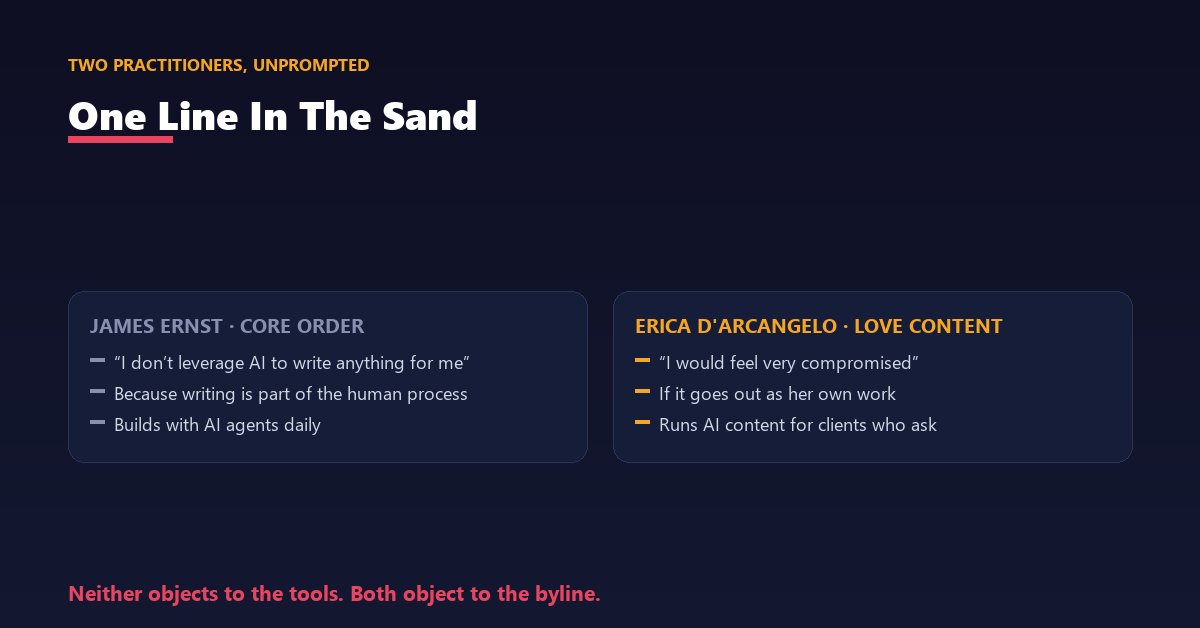
James Ernst runs Core Order, which he describes as a growth architecture firm. His whole business is embedding AI and automation into how companies operate; he built his own assistant to run his life, he writes his own code, he uses agent tooling daily. He is about as far from an AI sceptic as a person can be.
Erica D’Arcangelo runs Love Content Development, has a team of writers, and is openly pragmatic about the tools — she has clients who want AI-written content and she produces it for them. Her own words on the technology: “AI is a tool that makes really things faster and easier, and it’s an amazing research tool.”
So neither of them is objecting on principle to the technology. What they object to is something narrower and much more interesting.
Writing As Part Of The Human Process
Ernst was mid-answer about the value of human work in an AI-saturated market when he made the aside:
I do a lot of writing, I don’t leverage AI to write anything for me because that is something that is such a part of the human process that I want to keep that.
— James Ernst, Core Order, Unscripted Small Business
The reasoning underneath it is not about output quality. Ernst is not claiming his sentences are better than a model’s. He is saying the act of writing is part of how the thinking happens, and that outsourcing it removes the thinking rather than the typing.
Anyone who has drafted an argument and discovered halfway through that they did not actually believe it will recognise the claim. The page is where a position gets tested. Hand that step to a model and you get a document that reads like a position without anyone having held one.
Ernst is consistent about where he does draw value. His view of AI generally is that it should free human beings up to do what they do best — and he is explicit about wanting to keep “that human element the human in the loop” as part of the work. Writing is simply on the human side of his line.
I Would Feel Very Compromised
D’Arcangelo arrived at the same boundary from the direction of authorship. She writes literary fiction, young adult and children’s books alongside running the agency, and she separates that work from the tooling entirely:
That is something that I, as an artist, would feel very compromised if I used AI for something that I was putting out as my own work.
— Erica D’Arcangelo, Love Content Development, Unscripted SEO
The operative phrase is as my own work. This is not a claim that AI-assisted text is worthless — she produces it commercially for clients who ask for it. It is a claim about the relationship between a byline and a piece of writing, and about what it means to put your name on something.
She also offered one observation from her own client base that is worth recording precisely because she framed it modestly. Comparing outcomes, she said she does not necessarily see a difference in results between clients using AI and clients using human writers, but added: “I have seen a little bit with AI content where it will go up a lot at the beginning and then it will of trail off. That’s one of the trends that I’ve really seen just studying it a little bit, which I don’t see as much with human content.”
That is one practitioner’s pattern observation from her own accounts, not a study, and we are not going to inflate it into one. We report it because a lot of the confident numbers circulating on this question have considerably less behind them than one agency owner watching her own client charts.
What This Means For Agencies Buying Content
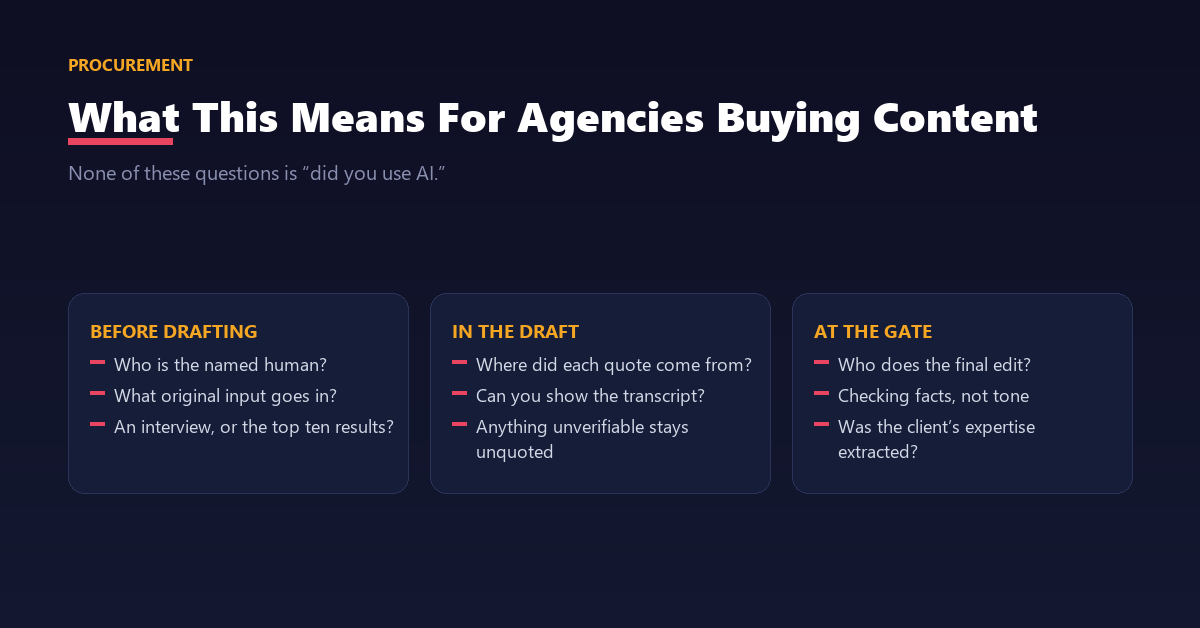
Our own guidance from here, offered as procurement practice rather than as anything either guest recommended. If you are buying content, the useful questions are about process, and they have to be asked before the work rather than after it.
- Who is the named human on this piece, and what have they actually done? Not the account manager. The person whose experience is supposed to be in the article.
- What original input goes in before drafting? An interview, a data pull, a site visit, a support-ticket review. If the honest answer is “the top ten results,” you are commissioning a summary of your competitors.
- Where do the quotes come from, and can I see the source? A transcript or a recording. Anything that cannot be checked back should not be inside quotation marks.
- Who does the final edit, and what are they checking for? Factual accuracy and first-hand experience, not tone.
- What happens to the client’s own expertise? The best answer is that somebody is scheduled to extract it. The worst is that nobody asked for it.
Notice that none of those questions is “did you use AI.” That question is unanswerable and largely irrelevant — both practitioners quoted here use these tools. The question that separates commodity work from work worth buying is whether anything entered the piece that was not already on the public web.
Our fuller argument is in separating AI content from human content, and the mechanics of how we run it are in the human-in-the-loop content workflow. If you want to talk through a specific programme, get started.
Buying content? Ask about the process, not the detector.
Every piece we deliver starts with a recorded interview and ends with a transcript you can check the quotes against.