
People assume a business built on human-written content must be against these tools. We are not, and pretending otherwise would be dishonest about how the work gets made. What we are precise about is the order — which stage a human occupies, and why moving that stage destroys the thing clients are paying for.
Nick Eubanks stated the order more compactly than we ever have.
The Order That Produces Good Work
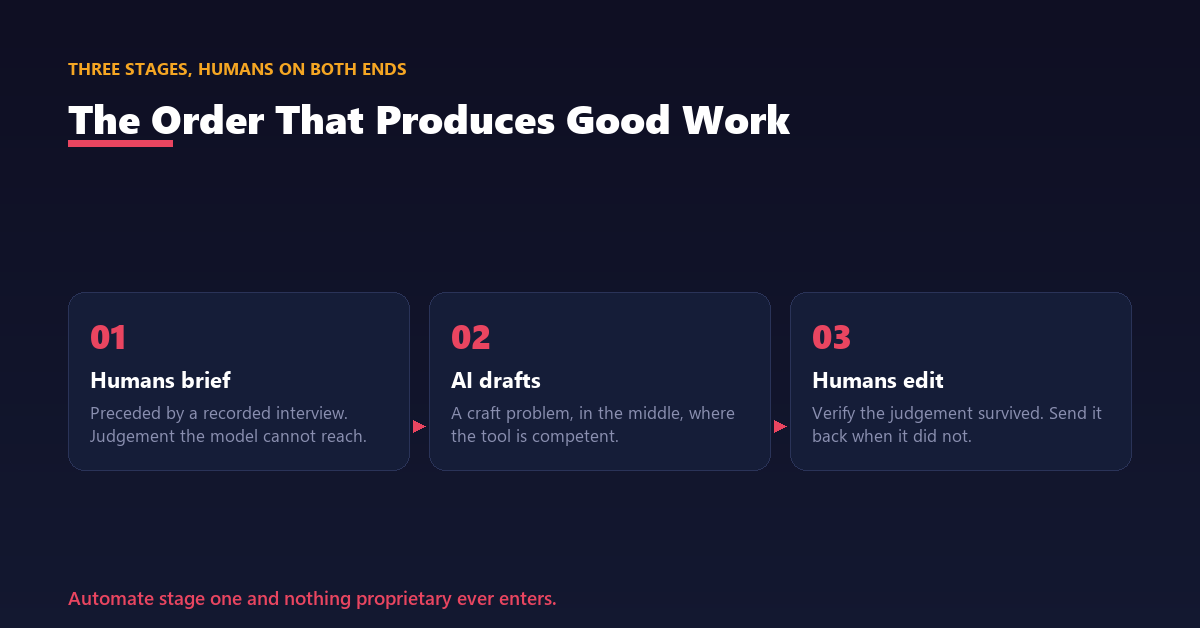
the best results that I’ve seen from a content perspective is where it’s humans actually doing the brief still and then it’s AI writing the draft and then it’s humans doing the editing.
— Nick Eubanks, Unscripted SEO
Three stages, humans on both ends. That is our production model, and it is worth being clear that we did not adopt it because a guest said so — we recognised it. It is what we were already doing, described better.
The reason it works is that the two human stages do different jobs. The brief supplies judgement that does not exist anywhere the model can reach. The edit verifies that the judgement survived into the text. Between those two points, drafting is a craft problem, and craft problems are exactly what these tools are competent at.
A Lot Of Agencies Have The Order Backwards
Eubanks is emphatic that using these tools is not optional — he does not think there is really a choice any more. His criticism is that the steps a lot of teams choose to automate are, in his view, not the best ones. The brief is the obvious example, because it was always the painful, expensive stage: five questions in a form, a generated brief, five minutes instead of an hour.
His verdict on the resulting arrangement — AI briefs, human drafts, AI proofreads — is that it is completely backwards.
We will keep his qualification intact, because it matters: he says “a lot of people, a lot of agencies… or maybe even in-house teams,” not most. We have no survey either, and inflating his estimate to make our own case louder would be exactly the kind of unsourced claim we tell clients not to publish.
The consequence is what interests us commercially. Automate the brief and you have automated the only stage where anyone had to know something specific about the business. Everything downstream then draws on what is already public, which is a precise description of the commodity content nobody wants to be buying.
What Goes Into Our Brief Stage
Ours is unusual in one respect: it is preceded by a recorded conversation. The brief is not assembled from a SERP analysis and a form, it is assembled from a transcript of somebody who has actually done the thing.
- The interview. A practitioner, recorded, transcribed, kept. Everything else comes out of it.
- The claim the piece exists to make. One line, drawn from what the practitioner actually argued rather than from what ranks.
- The verbatim quotes, with speaker attribution. Selected at brief stage, not hunted for afterwards to decorate a finished draft.
- The first-hand specifics. Numbers, cases, the thing that went wrong. The material that could not have been assembled from reading.
- The prohibitions. Claims the client cannot make, positions they have moved away from, anything legal or regulatory.
The structure of the finished article then comes out of the conversation rather than out of an analysis of the ten pages already ranking — which is the difference between a piece that adds to the record and one that summarises it.
The Edit Pass Where Expertise Is Added
Editing here does not mean proofreading. The draft arrives readable; that is not what the stage is for. It is where somebody checks that the expertise made it through, and sends the draft back when it did not.
- Every quote checked against the transcript, character by character. Not tidied, not smoothed, not merged. If a quote has been improved it becomes a paraphrase, and a paraphrase in quotation marks is a fabrication regardless of intent.
- Speaker attribution verified. Confirm the words came from the person named and not from the interviewer. This is a real and recurring error, and it is the one that damages a client’s credibility most.
- Proprietary input present. If it was in the brief and is missing from the draft, the draft is incomplete.
- Every claim sourced or cut. Confident unattributed assertions are the characteristic tell of text assembled from a synthesis.
- Prohibitions checked in writing. Against the list, not against memory.
Why We Publish The Interview Behind The Article
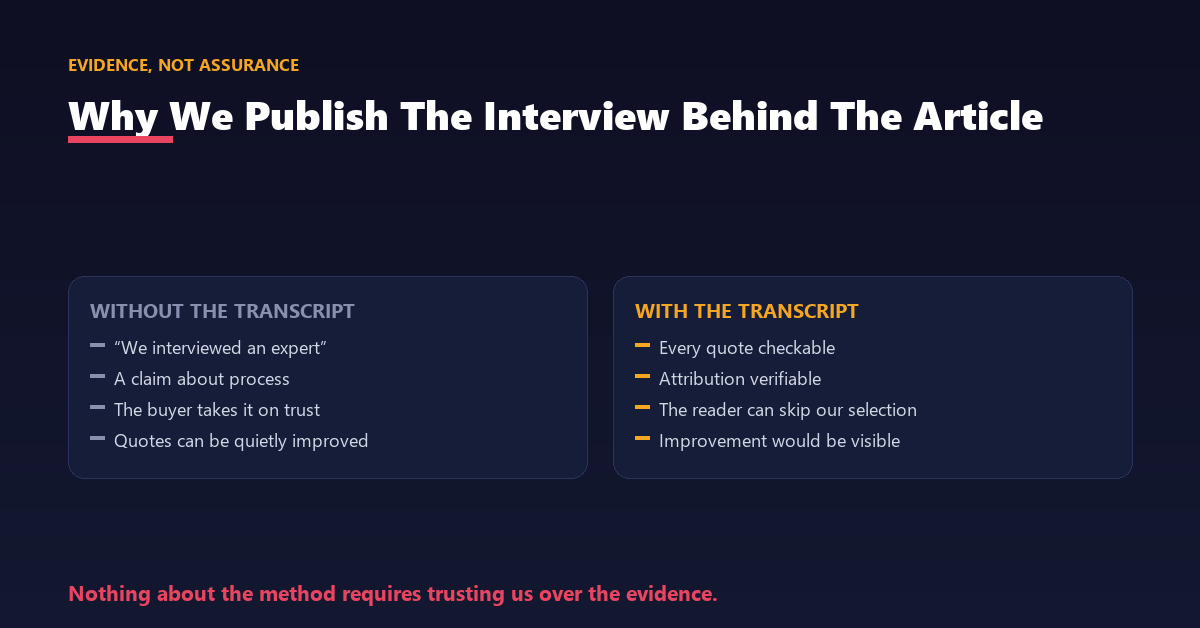
This is the part clients query most and it is the part we are least willing to drop. The transcript is the evidence. Without it, “we interviewed an expert” is a claim about our process that a buyer has to take on trust — which is exactly the position we tell them not to accept from anybody else.
It also imposes a discipline on us. Knowing the source will be published makes it impossible to quietly improve a quote, because the improvement would be visible. That constraint has caught mistakes in our own work, which is the strongest argument we have for keeping it.
And it is useful to the reader. Anyone who wants the full argument rather than our selection can have it. Nothing about our method requires the audience to trust us more than the evidence.
The mechanics are set out in the human-in-the-loop content workflow. What actually gets handed over is under deliverables, and if you want to run this on a live programme, get started.
Want the transcript published alongside the article?
Every piece we deliver is built from a recorded practitioner interview, and the source stays checkable.