
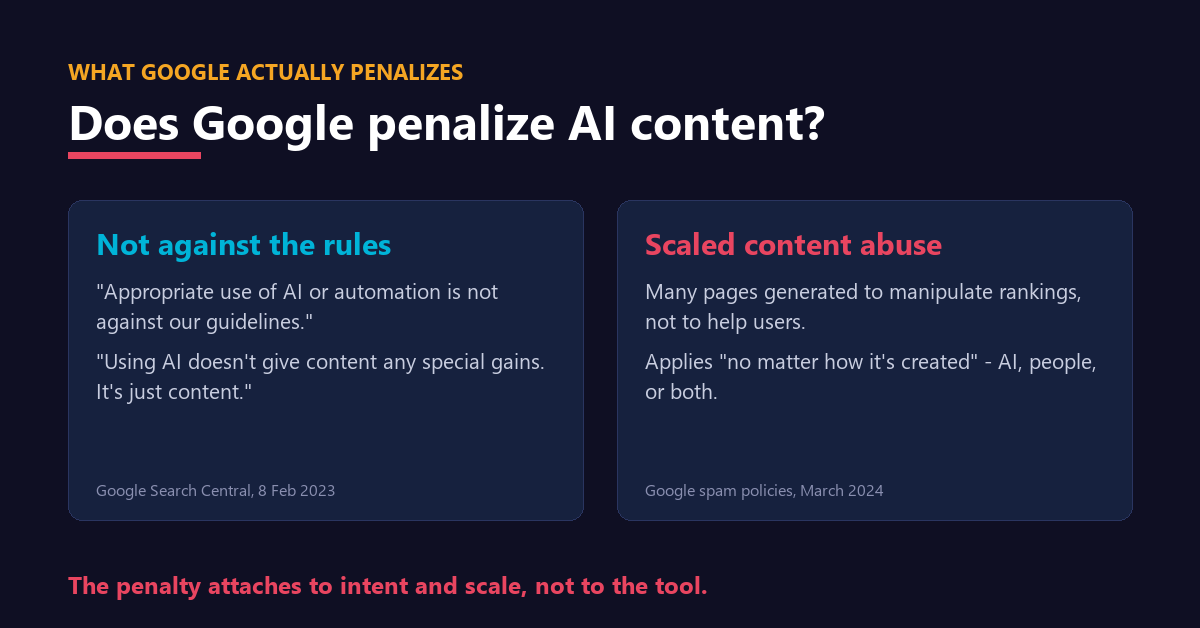
No. Google does not penalize content for being written by AI. It penalizes content that exists to manipulate rankings, and since 2024 it has had a named policy for doing that at volume. The distinction sounds like lawyering until you see what happened to the sites on each side of it.
Here is what Google has actually said, what four practitioners told us on the Unscripted SEO podcast about their own sites, and why “not penalized” is a much lower bar than most agencies treat it as.
01What Google actually says, in its own words
Google’s position has been on the record since February 2023, in a Search Central post titled Google Search’s guidance about AI-generated content. Two sentences carry it:
“Appropriate use of AI or automation is not against our guidelines.”— Google Search Central, 8 February 2023
“Using automation—including AI—to generate content with the primary purpose of manipulating ranking in search results is a violation of our spam policies.”— Google Search Central, 8 February 2023
The same post is blunt about the upside, too: “Using AI doesn’t give content any special gains. It’s just content.” Read that as the real answer. AI is neither a penalty nor a shortcut. It is a production method Google says it is not looking at.
02What does get punished: scaled content abuse
In March 2024 Google gave the manipulation half a name. Its spam policies now define scaled content abuse as “when many pages are generated for the primary purpose of manipulating search rankings and not helping users,” and the first example listed is “using generative AI tools or other similar tools to generate many pages without adding value for users.”
Notice the phrase that follows the definition: “no matter how it’s created.” A content farm staffed by underpaid writers is in scope. A careful team using a model to draft is not, as long as the pages are for people. The March 2024 announcement says the policy applies whether content is produced “through automation, human efforts, or some combination.”
The enforcement was not small. When that rollout finished, Google reported on its own blog that searchers would “see 45% less low-quality, unoriginal content in search results” (Google, update dated 26 April 2024). That is Google grading its own homework, so treat it as their claim rather than an independent measurement.
03What practitioners have seen on their own sites
The official line and the field reports agree more than people expect.
Scott Hendison of Search Commander ran the test himself on a local service site built entirely from model output:
“I’m running my own experiment on a local service website that’s got nothing but pure AI content… It’s doing okay, it’s getting more and more visibility. The more pages that get added, the more impressions it gets. It’s not crushing it or doing super well, but it’s only been a couple months and the pages are getting indexed.”— Scott Hendison, Search Commander
So no automatic penalty. Also no breakout. “Doing okay” after a couple of months is the honest ceiling of that experiment, and he said so.
Ann Smarty described the other end, the churn model that scaled content abuse was written for:
“it’s also a… very popular model still to create a website, achieve traffic within three months by publishing… high volumes of AI generated content. Enjoy your three months of traffic and then get suspended and switch to another website doing pretty much the same.”— Ann Smarty, Smarty Marketing
And Zak Ali, whose corner of the industry took the hit from the helpful content update, pushed back on blaming AI for it at all. “AI wasn’t the thing that really sort of forced this awakening,” he said. His read: the updates were “so heavily preferenced towards brand and providers” that comparison and affiliate sites got squeezed out. He also made the point we think matters most: slop is older than the models. “I think it’s been here when we all started copying each other to try and rank… And AI has just multiplied that.”
04Not penalized is not the same as worth ranking
Here’s where most AI content strategies quietly fail. The page isn’t punished. It just never earns anything, because it says what the top ten results already say.
Jon Gillham, whose company Originality.ai sells AI detection, put it plainly: “Google doesn’t want to rank average.” His warning was specific to pages where the words are the product:
“if the thing that you’re trying to push out into the world is 750 words or 1500 words about a specific topic and that has been copied and pasted out of an AI, I think that is a really, really low chance of being a sustainable… traffic generating asset for you.”— Jon Gillham, Originality.ai
Zak Ali described what does lift a page, and it is the same thing we build around. Readers “don’t necessarily care if a human or a robot told them the answer to what is a credit card,” he said, but “they are going to care if you know CEO of this company was able to give you commentary.” That is information gain: something on the page that could not have been assembled from what already ranks.
05What this means if you publish for clients
An affiliate operator can burn a domain and start another. You can’t. Ann Smarty said it for every agency we talk to:
“We… work on behalf of clients… we just cannot afford that freedom and flexibility to… game stuff, you know, and experiment with things. So we have to be more careful than anyone else.”— Ann Smarty
So the practical test for any page you ship under a client’s name has three questions, and none of them is “was AI involved?”
- Would this page exist if search engines didn’t? If the only reason to publish it is a keyword, you are closer to scaled content abuse than you think, whoever typed it.
- What is on it that the top ten don’t have? A named expert, a real number, a first-hand result. If the answer is “better formatting,” it is average.
- Who checked it? A human-in-the-loop workflow means somebody accountable read it and could defend every claim. Gillham’s line: “anything that doesn’t have a human in the loop is high risk.”
We use models for drafting too, in the order we laid out in humans brief, AI drafts, humans edit. What the model never supplies is the brief, because the brief starts with a recorded conversation it was not part of.
06The honest limit
None of this is a controlled test. Hendison’s experiment is one site over a couple of months, Smarty is describing a model she has watched rather than run, and Google’s 45% figure is self-reported. What lines up across all of them is narrower and more useful: the penalty attaches to intent and scale, not to the tool. If you want to know whether your own pages are at risk, stop asking how they were written and ask what they add.
Want content like this for your clients?
Human-led, AI-accelerated, expert-reviewed. We build SEO content that reads — and ranks — like a real person wrote it, because one did.