
Every content team that has started using a language model has run into the same uncomfortable moment. The draft comes back. It is competent. It is on topic. It covers the points the brief asked for. And nobody can say what is wrong with it, only that it does not seem to be worth publishing.
Jessica Malnik, who runs The Remote Work Tribe and has spent years building content for SaaS companies, gave us the cleanest test for that moment on Unscripted Small Business. It is ruthless, it takes about four seconds, and it does not require you to have an opinion about AI at all.
The Test Every Draft Should Fail Or Pass
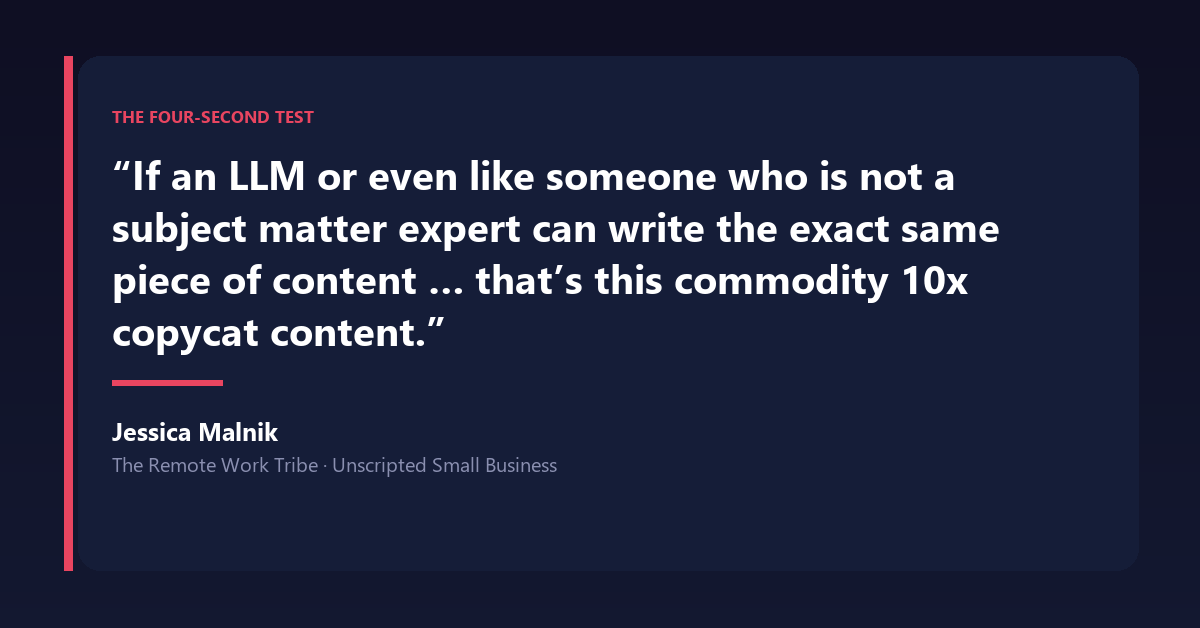
Malnik’s framing starts before the draft exists. She wants a content team to be able to answer why the piece is being made at all — in her words, “what can we add to the conversation that hasn’t already been said.” The test is what happens when you cannot answer that:
if an LLM or even like someone who is not a subject matter expert can write the exact same piece of content…
— Jessica Malnik, The Remote Work Tribe
Notice what she does not say. She does not say the piece is bad, or thin, or that a robot wrote it. She says somebody else could have written the same thing — and that this is true whether the somebody else is a model or a competent generalist human who has never done the job the article describes. The failure is not authorship. The failure is substitutability.
This is why we find the test more useful than any AI-detection score. Detection asks a question about process that nobody can reliably answer and that readers do not care about. Malnik’s test asks a question about value that anyone on the team can answer honestly in one pass.
From 10x Copycat To 1000x Copycat
The phrase Malnik uses for the result is worth sitting with, because it names something the industry has been describing badly for two years:
That’s this commodity 10x copycat content. Now it can be 1,000X copycat content because anyone can do that…
— Jessica Malnik, The Remote Work Tribe
The copycat problem is older than the models. For a decade the standard content play was to read the ten pages ranking for a term and write an eleventh that contained everything in all ten. That was already copying; it just cost enough in hours that the volume stayed low. What changed is not the nature of the content but its marginal cost, and therefore its quantity.
That matters for how you respond. If the problem were quality, the answer would be to edit harder. Because the problem is substitutability, editing harder does almost nothing — a better-written version of a page anyone could have written is still a page anyone could have written. The only fix is to put something in the piece that was not available to whoever else might write it.
What A Subject Matter Expert Adds That Cannot Be Faked
Malnik is specific about what that something is. Asked what to build a piece around, she lists the inputs a model has no access to:
whether it is original research, whether it is getting quotes, whether it is interviewing people within your team, or, you know, kind of showcasing your own first-hand experiences, things that an LLM can’t do.
— Jessica Malnik, The Remote Work Tribe
Every item on that list has the same shape. Each one is a fact that exists inside your organisation, or inside a named person, and nowhere on the public web. Original research is a number nobody else has run. A quote is a sentence that did not exist until somebody said it out loud. First-hand experience is the specific way a thing went wrong for you in March.
This is the distinction we build our production around, and it is also the honest limit of it. A subject matter expert is not automatically a better writer — often they are a worse one. What they are is unsubstitutable. The writing craft can be supplied. The knowledge cannot be, and the whole job of a content process is to get one into the room with the other.
It also explains something teams find counter-intuitive: the more specific and less search-shaped a claim is, the harder it is to copy. “Best CRM software” can be written by anyone. “Why we moved off our CRM after fourteen months and what the migration actually cost” can be written by exactly one company.
Sourcing Expertise When You Do Not Have It In-House
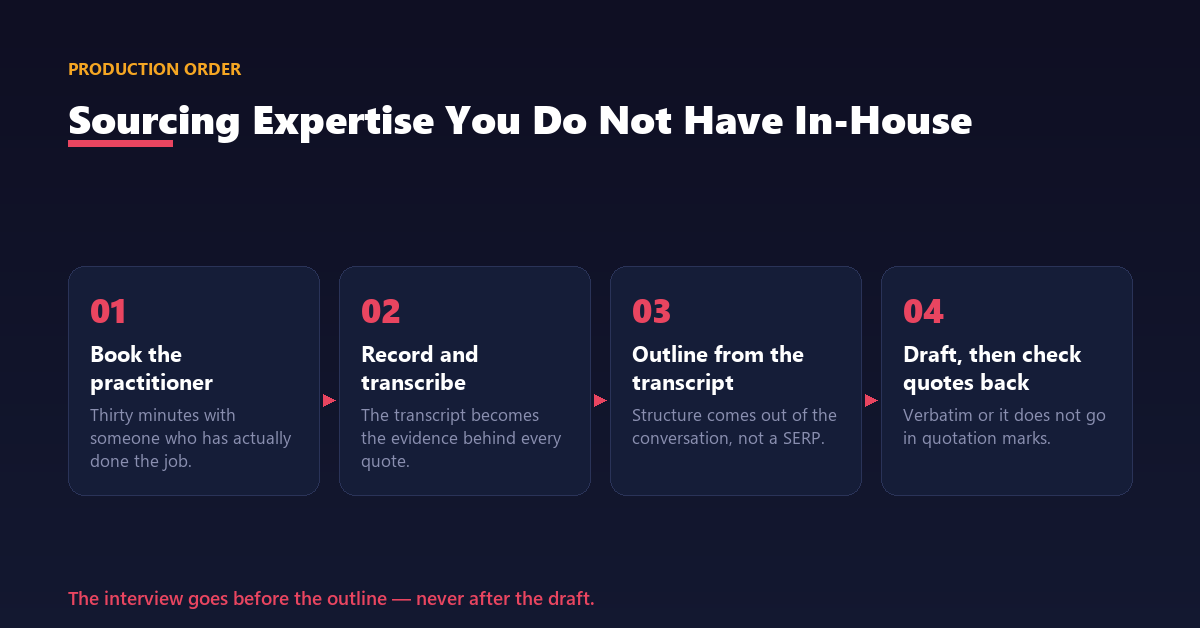
The obvious objection is that most teams commissioning content are not the experts. A marketing manager at a logistics company is not a logistics operator; an agency writing for a dental group has never placed an implant. Malnik’s own answer points at other people — getting quotes, interviewing people within your team. In other words: you do not have to be the expert. You have to go and get one.
Practitioner guidance, based on how we run it rather than on anything said in the episode: the sequence matters more than the effort. Teams that add expert input after a draft exists use it as decoration, dropping a quote into a paragraph that was already written without it. Teams that record the conversation first end up with an article whose structure could only have come from that conversation.
- Book the conversation before the outline. Thirty minutes with a practitioner changes what the piece is about, which is not something you can retrofit.
- Record it and keep the recording. The transcript is the evidence that the claims in the article came from a person, and it is what you check the quotes back against.
- Quote verbatim, with the speaker attributed. A tidied quote is a paraphrase wearing quotation marks, and it destroys the one thing the interview was for.
- Keep the parts that surprised you. The passages that did not fit your assumptions are the ones no competitor’s draft will contain.
Run Malnik’s test on the result. If a model or a smart outsider could have written the same page, the interview did not make it into the work — and no amount of editing will put it there.
The longer argument for why this is the durable position sits in our piece on information gain and uncopyable content. The practitioners we draw on are collected in the expert library, and the specific things we hand over are listed under deliverables.
Want content only your experts could have produced?
We start with a recorded practitioner interview, then build the article around what only that person could say — quotes verbatim, sources named.