
Every argument for human-written content eventually has to answer one hard question: what, precisely, can a person do that a model cannot? “It has soul” is not an answer a buyer can act on. “Google prefers it” is a claim about a policy that could change next quarter. The honest answer has to be structural — something about how the two kinds of mind actually work.
Chris Garrett gave the best version of that answer we have heard. He has been in digital marketing for roughly thirty years — UK SEO in the AltaVista era, a long stint at Copyblogger and StudioPress, marketing director at WP Engine — and he is not a sceptic. He builds with these tools. He runs a retrieval database trained on his own transcripts. Which is what makes his account of the limit worth taking seriously.
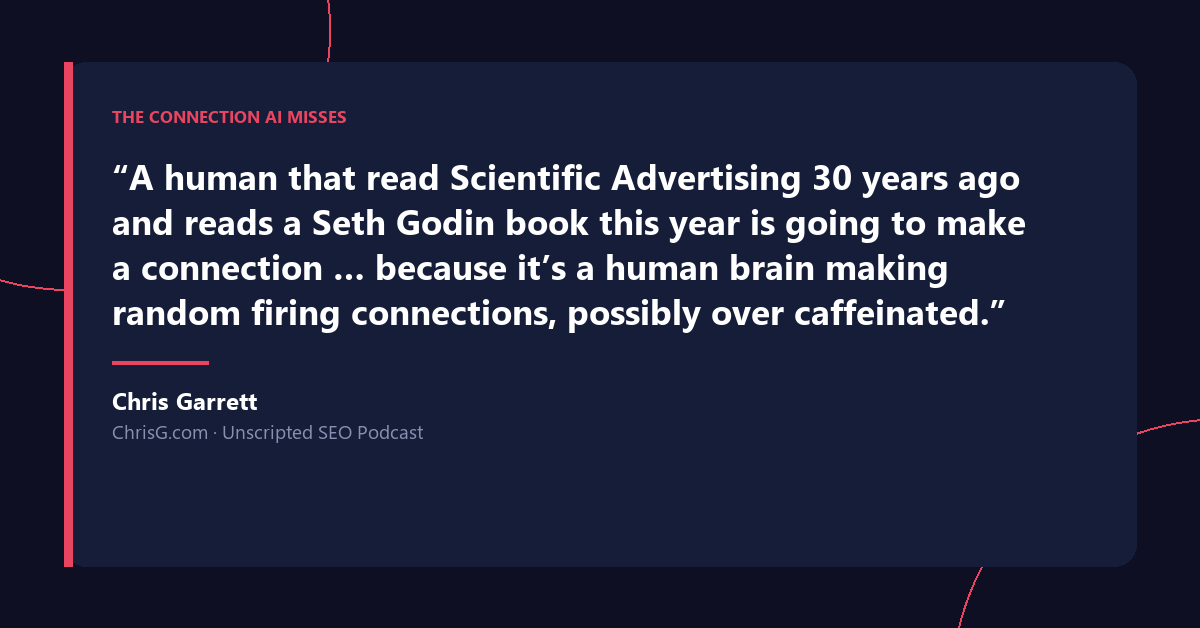
01Garrett on the over-caffeinated human brain
Speaking on the Unscripted SEO Podcast, Chris put it like this. Start with the copywriter who has only ever worked alongside a language model: they will think the craft is entirely hooks, headline structures and yellow highlighter, because that is the visible surface of every high-performing page the model was trained on. Then the contrast:
“A human that read scientific advertising 30 years ago and reads … Seth Godin book this year is going to make a connection and is going to say something that even the best AI tool isn’t going to be able to find a connection between — because it’s a human brain making random firing connections, possibly over caffeinated.”— Chris Garrett, Unscripted SEO Podcast
Sit with the specifics, because they are doing the work. Claude Hopkins published Scientific Advertising in 1923. Seth Godin is writing now. The two are not linked in any corpus, not co-cited in any dataset, not adjacent in any embedding space worth the name. The only place that connection exists is inside one person who happened to read both and happened to be thinking about your problem on a Tuesday afternoon.
That is not a mystical claim. It is a claim about where the edge is. A model is superb at the dense middle of what has been written. The connection Chris is describing lives at the sparse edge — and the sparser it is, the more valuable it is, and the less likely any amount of training data is to contain it.
02Why pattern matching is not insight
The counter-argument is that this is just pattern matching at a longer range, and models will get there. Jessica Malnik, who has spent years building content and internal tooling for remote teams, described in her own Unscripted interview what actually happens when you lean on these systems for judgment rather than production:
“They’re pattern matching machines and they’re gonna break not in the ways that, you know, it would break if you delegate it to a human. They’re gonna break in new ways that if you’re not thinking that through, could create a whole bunch of problems.”— Jessica Malnik, Unscripted Small Business Podcast
She was talking about vibe-coded internal tools, but the failure mode transfers exactly to content. A person who does not know a subject writes something obviously thin, and you catch it. A model that does not know a subject writes something fluent, confident and structurally perfect, and you do not. The error surface is completely different.
Chris makes the same point as a working rule, and he includes himself in it:
“AI tools are really helpful in domains that you’re well versed in, but don’t try to use it in a domain that you don’t know very well because you don’t spot the inaccuracies and the hallucinations.”— Chris Garrett, Unscripted SEO Podcast
He is a programmer, so he sees when generated code goes off the rails; he has watched people ship vibe-coded WordPress plugins that open their sites to attack. His most deflating example is smaller than that. He once asked an early ChatGPT for a Commodore 64 BASIC program and it hallucinated — on a language that has not changed since the 1980s and is exhaustively documented.
Read the rule the other way and it is a hiring specification. The only person who can safely operate one of these tools on your topic is somebody who already knows your topic well enough to catch it lying. Which is the argument that expertise is the moat, arrived at from the direction of risk rather than quality.
03Where are the people in all of this
Chris’s wider worry is not about any single article. It is about what the whole system is being fed. He described the loop directly:
“If you look to just Google and Gemini, they create podcasts using virtual voices with hallucinated content. And then people get them to be transcribed by AI and summarize the transcription. Where are the people in all of this? Where does the money come from?”— Chris Garrett, Unscripted SEO Podcast
Two separate problems are stacked in that quote, and the second is the one that should worry anyone commissioning content. The first is quality: synthetic material summarised by other synthetic systems adds nothing new at any step. The second is economic. The practitioners who generated the genuinely new material — the ones who ran the test, lost the money, fixed the thing at two in the morning — were funded by an ecosystem that is now being routed around. If nobody pays for the original observation, eventually nobody makes one.
Chris’s read on where value migrates is unsentimental: toward things that are verifiably human. Live experience where you know it is not a hologram or an AI character. Tangible work that is visibly imperfect because a person was involved in making it. Scarcity does not care about your feelings; it just moves.
04What we do differently on every brief
None of this amounts to “never touch AI.” It amounts to a rule about where the value has to originate. So we enforce it at the brief, before a word is drafted, rather than auditing for it afterwards.
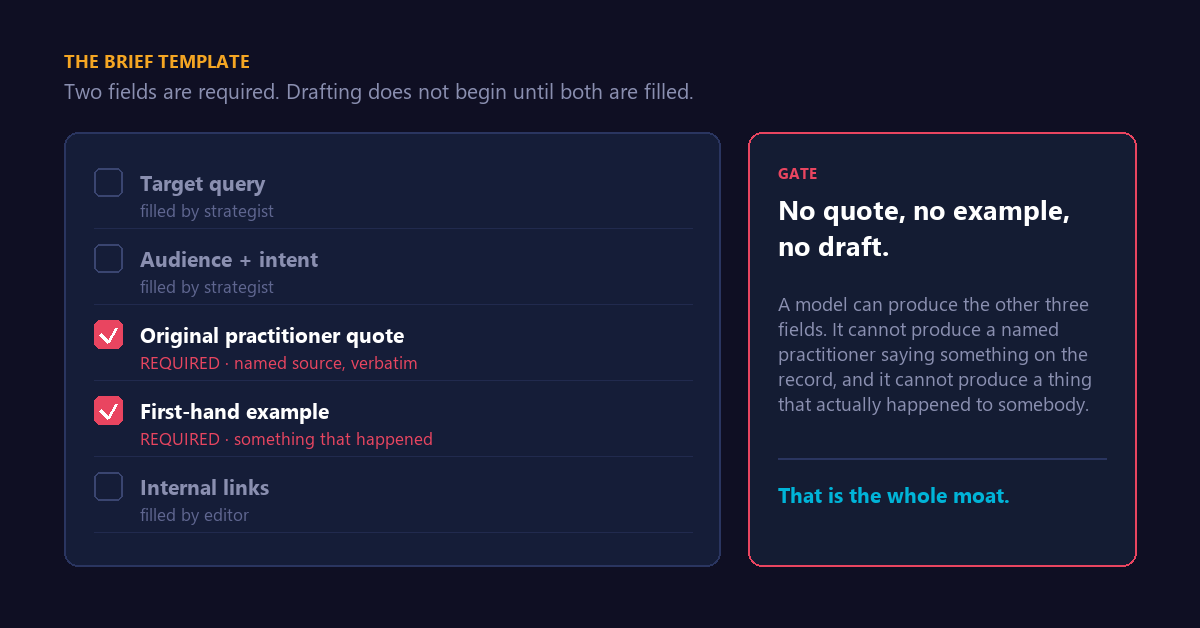
Two fields on every brief are non-negotiable. The first is an original practitioner quote — a named person, on the record, in their own words, pulled from an interview we actually recorded rather than a quote database. The second is a first-hand example: a thing that happened, with enough specificity that it could not have been generated. Everything else on the brief — the target query, the audience, the internal links — a competent model could produce. Those two, it cannot.
That is why the raw material is interviews rather than research. Every piece we build starts from our expert library of recorded conversations with working practitioners, which is where a quote like Chris’s comes from in the first place. It did not exist on the web before he said it out loud.
It is also why we keep the transcript wording rather than tidying it. Chris’s sentence about the over-caffeinated brain is slightly disfluent, the way real speech is. Smoothing it would make it read better and mean less — and it would quietly turn a verifiable quote into a paraphrase nobody can check.
If you want the longer version of the argument, it is set out in the case for genuinely human content. If you would rather see the machinery, how it works walks through the whole path from recorded interview to published page.
Want content a machine could never have written?
We turn real expert interviews into SEO content with genuine information gain — the kind Google and the LLMs actually reward.