
AI workslop is AI output that looks finished and is wrong: the report with the wrong data, the deck with the wrong content, the blog post that reads cleanly and says nothing a client could defend. Dr. Gleb Tsipursky, a behavioral scientist and CEO of Disaster Avoidance Experts, makes the case that most of it is not a tooling problem. It is what people produce when they are told to use a tool they believe is training their replacement.
That matters to any agency shipping content under a client’s name. If workslop is a people problem, a better model will not fix it, and a faster editor will not catch all of it. Here is what Gleb told the Unscripted Small Business podcast, and what it changes about how you check a draft.
01What AI workslop is, and why it passes a quick read
The term comes from a study Gleb cited on the show: research by Stanford and BetterUp Labs, written up in Harvard Business Review as AI-generated “workslop” is destroying productivity (September 2025). His summary of what they found:
“that’s poor AI outputs that look polished, but they have some problems in them. And each instance took about two hours to correct.”— Dr. Gleb Tsipursky, Unscripted Small Business
He put the share at 40% of respondents receiving workslop within the last month, which matches the HBR write-up. Treat that as a survey of office workers in general, not a measurement of content teams. Nobody has run the same count on agency blog output.
The two-hour figure is the one to sit with. Workslop does not cost you at the moment it is generated. It costs you at the moment somebody downstream has to work out what is wrong with it, and in an agency that somebody is usually the editor, the account manager, or the client.
Polish is the problem. A draft full of typos gets sent back. A draft with clean headings, confident sentences and one invented statistic gets approved, because it looks like the work was done.
02Workslop is resistance wearing a finished-looking file
Gleb’s central claim is that the people producing workslop are not lazy and not incompetent. They are responding rationally to what they think the tool is for. He described what happens when an owner demos an exciting AI build to the team:
“What they’re thinking is like, well, this thing will replace what I do. This thing will replace me. And they engage in various forms of non-compliance. They engage in various forms of resistance.”— Dr. Gleb Tsipursky, Unscripted Small Business
Later in the conversation he spelled out what that resistance looks like from the inside:
“why would you use something that by using it you are going to be replaced, right? Instead you’re going to be subverting it, you’re going to be like malicious compliance, you’re going to be resisting it, you’re going to be engaging in the work slop, you’re going to press the AI button.”— Dr. Gleb Tsipursky, Unscripted Small Business
Press the AI button. That is the whole behavior. The writer was told to use AI, so they used AI, minimally, and shipped whatever came back. When the output gets criticized, the lesson they draw is that the tool does not work. Gleb’s verdict on that reaction: “It’s rational, like it’s not dumb.”
If you run a content team, read that as a warning about your own incentives. A mandate to “use AI to hit volume” with no say in how produces exactly the output it deserves.
03The writers most likely to resist are the ones you hired to write
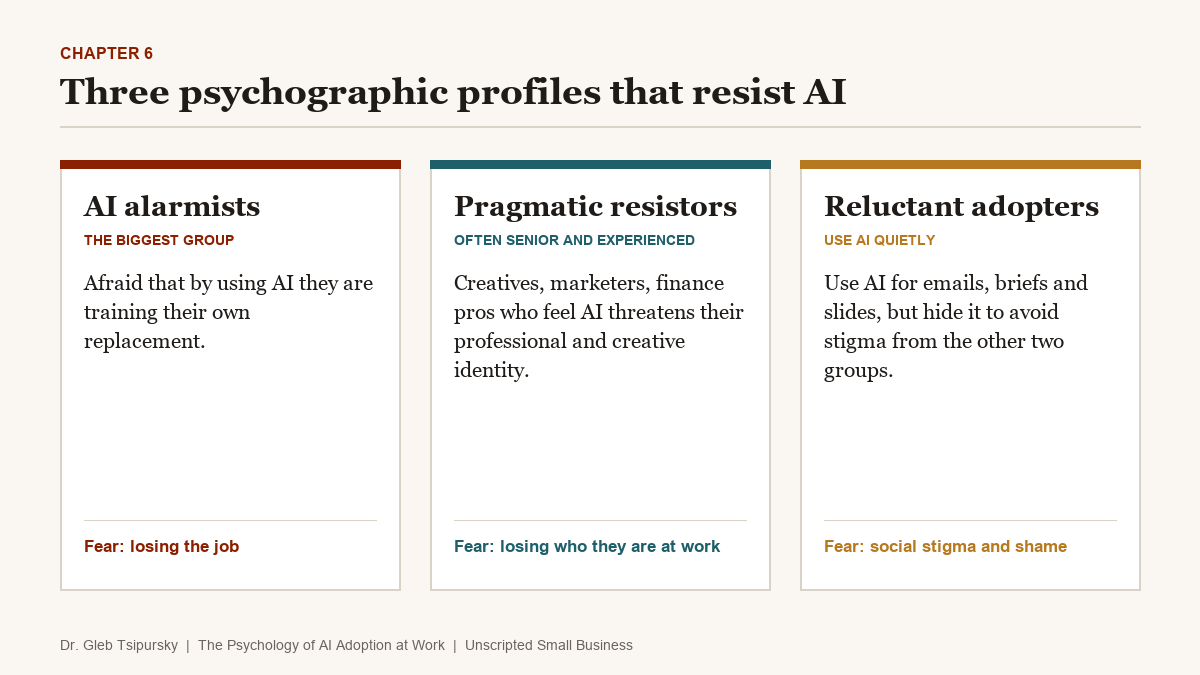
Gleb sorts AI resistance into three profiles, drawn from the research behind his book The Psychology of AI Adoption at Work. AI alarmists fear losing the job. Pragmatic resistors, often senior people, fear losing who they are at work. Reluctant adopters use AI but hide it to avoid the stigma from the other two groups.
The second group is the one agencies should think hardest about. Gleb described them as creatives who write copy and do digital marketing, threatened because the model can produce a passable version of their work. Those are your best writers. They are also the people whose judgment you are paying for when a client asks for content that carries real expertise.
The third group creates a different risk. A writer who uses AI quietly cannot ask for help reviewing what it produced, because admitting the tool was involved is the thing they are avoiding. The draft arrives with no disclosure, and your editor checks it as if a person wrote every line.
None of this shows up in a word count or a readability score. It shows up as a draft that is fluent and thin, written by someone who had stopped caring whether it was good.
04How to stop rewarding the AI button on a content team
Gleb’s fixes are written for business owners, but they translate directly to an agency content operation.
- Say what the tool is for, out loud. His first move for alarmists is a leadership decision to aim AI at growth, not headcount. For an agency, that means telling writers plainly that AI handles research gathering and first structure, and that their names stay on the work.
- Automate what writers hate first. For pragmatic resistors, Gleb surveys staff on the tasks they dislike and the things that block the work they are proud of, then builds prompts around those. In content, that is transcript searching, source formatting and meta fields, not the argument of the piece.
- Model it from the top. For reluctant adopters, he points to leaders talking openly about how they use AI. If the editor says which parts of a brief came from a model, the writer can too.
- Make disclosure the default. Ask every draft to say what was generated and what was checked. Hidden AI use is where unreviewed claims get through.
We wrote up the order we work in, where humans brief, AI drafts and humans edit, and the review step behind it in our human-in-the-loop content workflow. The brief is where workslop is easiest to prevent; The SEO Advisory makes the same argument in the brief is where the human belongs.
05An AI workslop check for every client article
Workslop survives review because reviewers check polish, and polish is the one thing AI output always has. Check the things a model cannot supply on its own instead:
- Every number has a source you opened. Not a source the draft names. A source somebody clicked and read, with the figure in it.
- Every quote traces to a recording or a document. If a named expert says something in the draft, you should be able to find the timestamp.
- One thing on the page the top ten results do not have. A first-hand result, an interview, a client number. If the answer is “better formatting,” it is average, and as we covered in does Google penalize AI content, average is the real risk.
- The writer can defend it without the file open. Ask one question about the piece. Someone who pressed the AI button usually cannot answer it.
That check takes minutes. The workslop it catches takes, by the study Gleb cited, about two hours each to fix, and longer once a client has found it first.
The broader point holds outside content too. The Organic Digital Collaborative makes a similar case for small businesses in let AI take the admin and keep the human piece. Give the model the busywork, and keep the judgment with a person who has a reason to care.
Quotes are verbatim from the raw Riverside transcript of the episode, trimmed only at the start and end. Full conversation: Dr. Gleb Tsipursky on the psychology of AI adoption, Unscripted Small Business.
Want content like this for your clients?
Human-led, AI-accelerated, expert-reviewed. We build SEO content that reads — and ranks — like a real person wrote it, because one did.