
There is a version of the AI-and-publishing argument that is entirely abstract, conducted by people whose livelihood was never on the line. Holly Homer is not in that version. She has been writing every day for over twenty years, has four books out, and ran kidsactivities.com — and she watched the thing happen to her personally.
Replaced By My Own Words In The Results
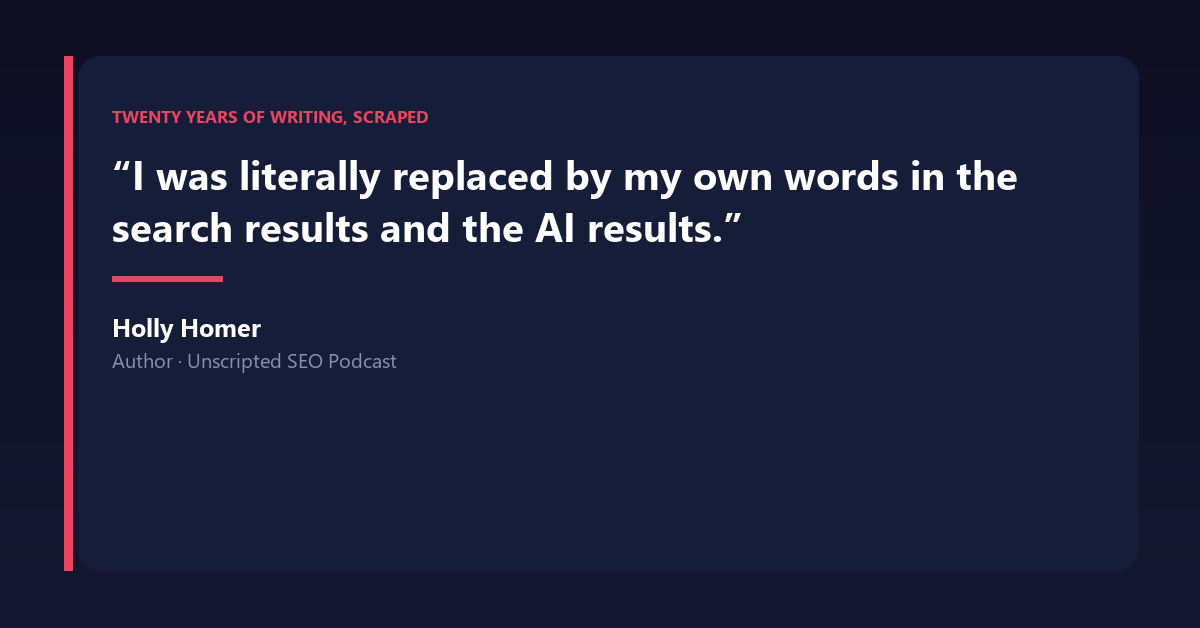
Her account of it, on Unscripted SEO, is precise about the mechanism and unsentimental about the outcome. She describes the AI having scraped her thirteen thousand blog posts and her four books without compensating her, and then:
I was literally replaced by my own words in the search results and the AI results.
— Holly Homer, Unscripted SEO
She adds the detail that explains why her category was so exposed: her main site was simple craft and activity content, and as she puts it, you do not need a four-thousand-word blog post to understand how to make a paper plate craft of a squirrel. The instruction was the whole product, the instruction is short, and a summary of a short instruction is a perfect substitute for it.
She is also candid about her own reaction — that she was, in her words, slightly bitter about it for a while — before moving on to what comes next. We are quoting the bitterness because leaving it out would make her sound more serene than she was, and the serene version of this story is the one nobody should trust.
What Publishers Lost And What They Kept
What was lost is straightforward: the traffic to content whose entire value was a fact or a procedure that fits in a paragraph. Homer’s case is the clearest possible version because her content was genuinely useful, genuinely popular, and genuinely substitutable once a machine could restate it.
What was kept is harder to name, and we want to be careful not to put a tidy thesis in her mouth. What she describes, in her own terms, is that the fundamentals of knowing exactly who your customer is and what problem they have are all still in play — and that in a world where everyone has become savvy about, for instance, obviously fake five-star reviews, the scarce thing is authenticity. Her observation is that there is no product in the world that has nothing bad about it, and audiences know it.
That is not a claim that human writing wins on quality. It is a claim about scarcity. When the supply of competent, comprehensive, agreeable text becomes effectively infinite, the things that stay rare are the ones that require a particular person to have been somewhere and formed a view.
Being Human As The Next Frontier
Homer’s conclusion — and this is the line the piece is built around — is that being human, in a place where being human is now unusual and special, is the next frontier. She said it about affiliate marketing and product selling specifically, and we think it generalises, but we are flagging the context because it is where the thought came from rather than dressing it up as a universal law.
What makes it credible coming from her is precisely that she is not making a sentimental argument. She is a commercial publisher who lost a traffic model and is describing where the remaining advantage sits. It is a market observation, not a manifesto.
Which is, in fairness, our whole position, held by someone with far more to lose by holding it.
The Content That Survives Summarisation
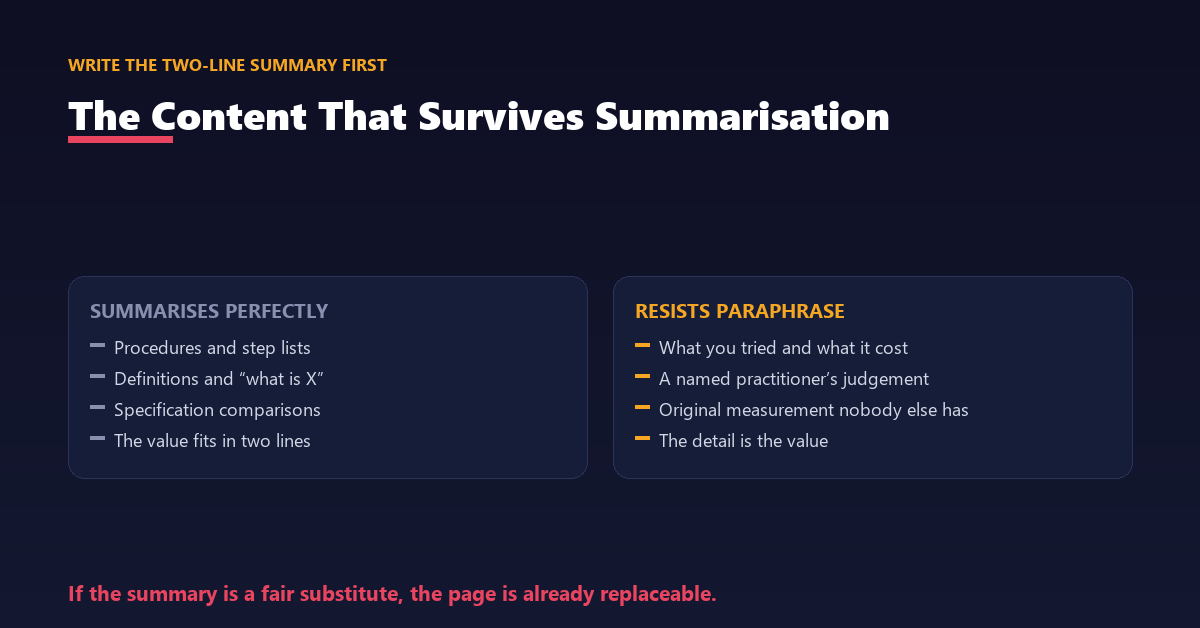
Our own working test, developed from watching this pattern rather than stated by Homer. Write the two-sentence summary of your page. Then ask whether a reader who only saw the summary would have any reason to open the page.
- Procedures die. If the value is the steps, the steps summarise perfectly. This is Homer’s paper-plate squirrel.
- Definitions die. “What is X” is a sentence with an article wrapped around it.
- Comparisons mostly die. A specification table is exactly the kind of thing a machine collates better than you do.
- An account of what happened survives. What you tried, what went wrong, what it cost, what you would do differently. There is nothing to compress because the detail is the value.
- A named person’s judgement survives. Not “experts say” — a specific practitioner willing to be wrong in public, quoted verbatim.
- Original measurement survives. A number nobody else has cannot be summarised from anywhere else. It can only be cited.
None of this makes procedural content worthless. It makes it a cost of doing business rather than an asset — the thing you publish because customers need it, not the thing you publish expecting it to earn.
The longer argument for why everything converges when the input is the same is in why AI content blurs together. The positive case is expertise is the moat, and the practitioners we draw on are in the expert library.
Publishing something a summary cannot replace?
We build content around a named practitioner’s account of what actually happened — the part that has nothing to compress.